Thinking like an investigator: Criminal Investigation Workbook

Author(s)
David Byrne
Edition
1
Pages
170
Book Type
Academic

CHOOSE YOUR FORMAT

Help Me Choose

Paperback Book

$85.00

ISBN: 9798319740366
Details: 
Print Product

eBook

$65.00

ISBN: 9798319740373
Details: 
Electronic Delivery EBOOK - 365 days

CHOOSE YOUR FORMAT

Help Me Choose

Paperback Book

$85.00

ISBN: 9798319740366
Details: 
Print Product

eBook

$65.00

ISBN: 9798319740373
Details: 
Electronic Delivery EBOOK - 365 days

Thinking Like an Investigator: The Criminal Investigation Workbook is an interactive, hands-on workbook designed to develop the practical skills used by criminal investigators in the field. Through realistic exercises and case-based activities, students and aspiring investigators will strengthen their observation skills, conduct surveillance operations, perform neighborhood canvasses, interview witnesses, develop investigative theories, create crime scene sketches, and analyze fingerprint evidence. The workbook bridges the gap between theory and practice by providing professional templates and investigative tools commonly used in criminal investigations, including search warrants, witness statements, neighborhood canvass forms, interview worksheets, and evidence documentation forms. Whether used in the classroom, training academy, or independent study, this workbook offers an engaging and immersive learning experience that encourages critical thinking, analytical reasoning, and the systematic approach required to successfully investigate criminal activities.

David Byrne

Dr. David S. Byrne is currently an Assistant Professor at St. John's University in the Criminal Justice & Homeland Security department and teaches courses in Crime Scene Investigation, Intelligence Analysis, Criminal Investigations, and Counterterrorism. Dr. Byrne has over 15 years of experience in law enforcement, having provided intelligence analytical support in cases involving violent transnational criminal organizations. He was also cross-designated as a Special Detective Investigator for the District Attorney offices in Queens, Richmond, and Manhattan counties in New York where he assisted in the investigation and prosecution of organized crime networks involved in narcotics trafficking, violent extortions, and racketeering offenses.

Since 2015, he also taught at SUNY Farmingdale College, Center for Criminal Justice; courses included Criminalistics, Computer Forensics, and Intelligence Operations. Dr. Byrne was the recipient of the prestigious SUNY Chancellor's Award for Excellence in Adjunct Teaching (2023-2024) and received two grants for the development of a Mock Crime Scene simulation program at the school, see https://youtu.be/uwJahkCNsnA

Dr. Byrne's teaching method focuses on applied and experiential learning through the incorporation of hands-on learning activities to improve student outcomes, critical thinking skills, and long-term knowledge retention. His research interests focus on improving criminal justice education via technology simulations, cybersecurity, digital forensics, and intelligence studies and has published articles in these areas in scholarly journals and authored two books.

Dr. David Byrne earned his Doctorate (Ph.D.) in Information Science with a concentration in Criminal Justice Technologies, a Master of Science in Criminal Justice both from LIU Post, New York and a second Masters in Library & Information Science, from St. John's University in New York.

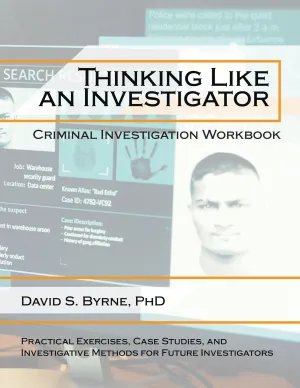
Thinking Like an Investigator: The Criminal Investigation Workbook is an interactive, hands-on workbook designed to develop the practical skills used by criminal investigators in the field. Through realistic exercises and case-based activities, students and aspiring investigators will strengthen their observation skills, conduct surveillance operations, perform neighborhood canvasses, interview witnesses, develop investigative theories, create crime scene sketches, and analyze fingerprint evidence. The workbook bridges the gap between theory and practice by providing professional templates and investigative tools commonly used in criminal investigations, including search warrants, witness statements, neighborhood canvass forms, interview worksheets, and evidence documentation forms. Whether used in the classroom, training academy, or independent study, this workbook offers an engaging and immersive learning experience that encourages critical thinking, analytical reasoning, and the systematic approach required to successfully investigate criminal activities.

David Byrne

Dr. David S. Byrne is currently an Assistant Professor at St. John's University in the Criminal Justice & Homeland Security department and teaches courses in Crime Scene Investigation, Intelligence Analysis, Criminal Investigations, and Counterterrorism. Dr. Byrne has over 15 years of experience in law enforcement, having provided intelligence analytical support in cases involving violent transnational criminal organizations. He was also cross-designated as a Special Detective Investigator for the District Attorney offices in Queens, Richmond, and Manhattan counties in New York where he assisted in the investigation and prosecution of organized crime networks involved in narcotics trafficking, violent extortions, and racketeering offenses.

Since 2015, he also taught at SUNY Farmingdale College, Center for Criminal Justice; courses included Criminalistics, Computer Forensics, and Intelligence Operations. Dr. Byrne was the recipient of the prestigious SUNY Chancellor's Award for Excellence in Adjunct Teaching (2023-2024) and received two grants for the development of a Mock Crime Scene simulation program at the school, see https://youtu.be/uwJahkCNsnA

Dr. Byrne's teaching method focuses on applied and experiential learning through the incorporation of hands-on learning activities to improve student outcomes, critical thinking skills, and long-term knowledge retention. His research interests focus on improving criminal justice education via technology simulations, cybersecurity, digital forensics, and intelligence studies and has published articles in these areas in scholarly journals and authored two books.

Dr. David Byrne earned his Doctorate (Ph.D.) in Information Science with a concentration in Criminal Justice Technologies, a Master of Science in Criminal Justice both from LIU Post, New York and a second Masters in Library & Information Science, from St. John's University in New York.