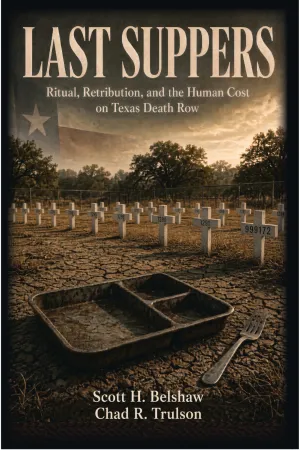
For nearly thirty years after Texas resumed executions, a condemned inmate at the Huntsville Unit could ask for one last thing: a meal. Some requested steak and peach cobbler. Some asked for a banana and a salad. Some asked for nothing. In 2011, after Lawrence Russell Brewer ordered an enormous feast and did not touch it, Texas ended the practice. From that day forward, the last tray was whatever the prison cafeteria was already serving.
This book is not a catalog of menus. It is an examination of a small ritual at the edge of state killing—what it meant, why it lasted, and what its abolition revealed about punishment in the state that has carried out more modern executions than any other. Belshaw and Trulson follow the custom from informal electric-chair tradition through the first lethal injection, the documented requests of the 1980s–2011 era, and the standardized meals that followed. Along the way they sit with the cases that still define the record: Charles Brooks Jr., Karla Faye Tucker, Kenneth McDuff, Brewer, and others whose final hours were never only about food.
The crimes come first. James Byrd Jr., Jerry Lynn Dean, Deborah Thornton, David Gregory, and the families who lived with what was taken remain at the center. The last meal, whether elaborate, modest, or refused, always arrived too late. The authors use that fact to look backward—at strain, labeling, learned violence, failed supervision, and the earlier points where intervention might have mattered—and forward, at what a justice system owes victims when it also claims to recognize the humanity of the person it has condemned.
Last Suppers is written for students, practitioners, and readers who want the ritual treated with seriousness rather than spectacle. The special requests are gone in Texas. The questions they raised about dignity, retribution, and prevention are not.