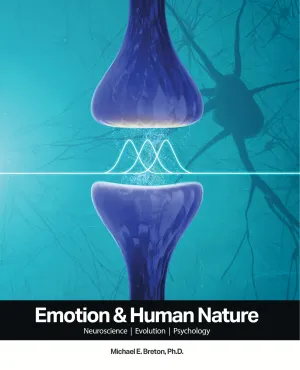
Emotion and Human Nature

Author(s)
Michael E. Breton
Edition
1
Pages
293
Book Type
Academic
Retail

CHOOSE YOUR FORMAT

Help Me Choose

eBook

$26.00

ISBN: 9798319743107
Details: 
Electronic Delivery EBOOK - 365 days

CHOOSE YOUR FORMAT

Help Me Choose

eBook

$26.00

ISBN: 9798319743107
Details: 
Electronic Delivery EBOOK - 365 days

Human nature can be better understood by looking to the origins of multicellular organisms about 1,000 million years ago. Even this billion-year perspective may not be enough given that multicellular life emerged from more than three billion years of evolving modes of molecular replication and single-cell evolution. 

How does human individual difference come about? Two factors contribute: variation in our genetic endowment and experiential knowledge acquired through our multifaceted, prodigiously extensive learning capacities. Genes, through the process of evolution, have invented capacities to learn. We have been invented by the processes, forces, and chance happenings of evolution through the action of genes. 

Emotion and the behavior driven by its' many forms have proven to be more difficult to study than cognitive processes because emotion is not so easily or precisely put into words. Being less well understood, emotional capacities have been underestimated as prime movers underlying decision making behavior central to human nature. Humans may be the most rational creatures on the planet, but their decision-making is nevertheless fundamentally grounded in emotion.

 In Emotion and Human Nature, Michael Breton examines the neurobiological foundations of animal and human emotion. A mathematical model of individual emotional variation is presented that is able to account for rare behavioral tendencies, both evil and altruistic. Human destiny is in the emotional makeup of ourselves, and secondarily in our rational abilities.

Michael E. Breton

Dr. Breton received his Ph.D. in Psychology (Sensation, Perception and Visual Psychophysics) from the University of Chicago in 1975 following graduation from Amherst College in 1971 (cum laude). In the middle of his undergraduate career, from 1966 to 1969, he served in the United States Army (Vietnam, 1966-67) at an enlisted rank of Sargeant, E5. He completed postdoctoral work at Columbia University (NIH Fellowship, 1975-77) and the National Research Council of Canada (1978-79). In 1979-80, he was selected to be a Congressional Science and Technology Fellow, working on social science research funding issues involving the National Science Foundation. From 1980 to 1995, he held faculty positions at Wills Eye Hospital (Philadelphia), the Children’s Hospital of Philadelphia (Pediatric Ophthalmology) and the University of Pennsylvania School of Medicine, Department of Ophthalmology. After 1995 he held administrative positions, including Associate Vice President for Research and Sponsored Programs at Rutgers, The State University of New Jersey. In semi-retirement, he now teaches courses in Behavioral Neuroscience, Sensation and Perception, Learning and Memory, and Developmental Psychology at the University of Rhode Island. He also teaches an Independent Study Seminar, based on his book (Emotion and Human Nature: Neuroscience, Evolution, and Psychology), on how emotional neural-synaptic mechanisms evolved and how they affect human decision-making behavior.

 

Human nature can be better understood by looking to the origins of multicellular organisms about 1,000 million years ago. Even this billion-year perspective may not be enough given that multicellular life emerged from more than three billion years of evolving modes of molecular replication and single-cell evolution. 

How does human individual difference come about? Two factors contribute: variation in our genetic endowment and experiential knowledge acquired through our multifaceted, prodigiously extensive learning capacities. Genes, through the process of evolution, have invented capacities to learn. We have been invented by the processes, forces, and chance happenings of evolution through the action of genes. 

Emotion and the behavior driven by its' many forms have proven to be more difficult to study than cognitive processes because emotion is not so easily or precisely put into words. Being less well understood, emotional capacities have been underestimated as prime movers underlying decision making behavior central to human nature. Humans may be the most rational creatures on the planet, but their decision-making is nevertheless fundamentally grounded in emotion.

 In Emotion and Human Nature, Michael Breton examines the neurobiological foundations of animal and human emotion. A mathematical model of individual emotional variation is presented that is able to account for rare behavioral tendencies, both evil and altruistic. Human destiny is in the emotional makeup of ourselves, and secondarily in our rational abilities.

Michael E. Breton

Dr. Breton received his Ph.D. in Psychology (Sensation, Perception and Visual Psychophysics) from the University of Chicago in 1975 following graduation from Amherst College in 1971 (cum laude). In the middle of his undergraduate career, from 1966 to 1969, he served in the United States Army (Vietnam, 1966-67) at an enlisted rank of Sargeant, E5. He completed postdoctoral work at Columbia University (NIH Fellowship, 1975-77) and the National Research Council of Canada (1978-79). In 1979-80, he was selected to be a Congressional Science and Technology Fellow, working on social science research funding issues involving the National Science Foundation. From 1980 to 1995, he held faculty positions at Wills Eye Hospital (Philadelphia), the Children’s Hospital of Philadelphia (Pediatric Ophthalmology) and the University of Pennsylvania School of Medicine, Department of Ophthalmology. After 1995 he held administrative positions, including Associate Vice President for Research and Sponsored Programs at Rutgers, The State University of New Jersey. In semi-retirement, he now teaches courses in Behavioral Neuroscience, Sensation and Perception, Learning and Memory, and Developmental Psychology at the University of Rhode Island. He also teaches an Independent Study Seminar, based on his book (Emotion and Human Nature: Neuroscience, Evolution, and Psychology), on how emotional neural-synaptic mechanisms evolved and how they affect human decision-making behavior.
 

Other Titles from this Author(s)

No other titles found of this author