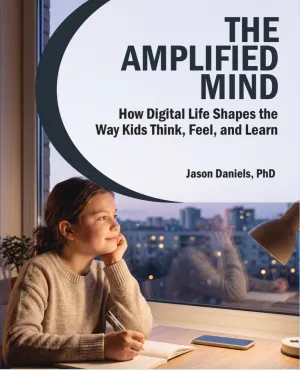
The Amplified Mind: How Digital Life Shapes the Way Kids Think, Feel, and Learn

Author(s)
Jason Daniels
Edition
1
Pages
293
Book Type
Retail

CHOOSE YOUR FORMAT

Help Me Choose

eBook

$13.00

ISBN: 9798319752949
Details: 
Electronic Delivery EBOOK - 365 days

CHOOSE YOUR FORMAT

Help Me Choose

eBook

$13.00

ISBN: 9798319752949
Details: 
Electronic Delivery EBOOK - 365 days

To understand children's digital habits, we need to understand how children develop. 

The screen-time debate usually begins with how much technology children use and how to limit it. But time on a screen is an outcome. It tells us little about why young people keep checking and scrolling, or what would actually help. 

In The Amplified Mind, Jason Daniels, PhD, reframes the screen-time debate as a developmental question. Children develop through experience, and what they repeatedly do shapes how they direct attention, respond to discomfort, evaluate themselves, and approach learning. Digital environments change those experiences, making quick rewards easier to practice and patience, boredom, and sustained effort harder.

Through five interconnected loops (reward, validation, comparison, relief, and certainty), Daniels shows why digital habits can take hold and where meaningful change can begin. 

Grounded in research and everyday examples, The Amplified Mind gives parents and educators a practical framework for supporting young people as they build the attention, emotional regulation, and independent thinking they need for digital life.

Jason Daniels

Jason S. Daniels, PhD, is an Assistant Professor of Education at Concordia University of Edmonton. His research explores how digital media use relates to learning, emotional regulation, and well-being, with a particular focus on adolescents and young adults. 

He is the author of Beyond the Screen and The Amplified Mind: How Digital Life Shapes the Way Kids Think, Feel, and Learn. Drawing on developmental and educational psychology, his work examines both the opportunities and challenges of digital life. He emphasizes moving beyond screen time alone to consider the habits, relationships, and environments that shape development, helping parents and educators support young people’s capacity to think, learn, and navigate an increasingly digital world.

To understand children's digital habits, we need to understand how children develop. 

The screen-time debate usually begins with how much technology children use and how to limit it. But time on a screen is an outcome. It tells us little about why young people keep checking and scrolling, or what would actually help. 

In The Amplified Mind, Jason Daniels, PhD, reframes the screen-time debate as a developmental question. Children develop through experience, and what they repeatedly do shapes how they direct attention, respond to discomfort, evaluate themselves, and approach learning. Digital environments change those experiences, making quick rewards easier to practice and patience, boredom, and sustained effort harder.

Through five interconnected loops (reward, validation, comparison, relief, and certainty), Daniels shows why digital habits can take hold and where meaningful change can begin. 

Grounded in research and everyday examples, The Amplified Mind gives parents and educators a practical framework for supporting young people as they build the attention, emotional regulation, and independent thinking they need for digital life.

Jason Daniels

Jason S. Daniels, PhD, is an Assistant Professor of Education at Concordia University of Edmonton. His research explores how digital media use relates to learning, emotional regulation, and well-being, with a particular focus on adolescents and young adults. 

He is the author of Beyond the Screen and The Amplified Mind: How Digital Life Shapes the Way Kids Think, Feel, and Learn. Drawing on developmental and educational psychology, his work examines both the opportunities and challenges of digital life. He emphasizes moving beyond screen time alone to consider the habits, relationships, and environments that shape development, helping parents and educators support young people’s capacity to think, learn, and navigate an increasingly digital world.

Other Titles from this Author(s)