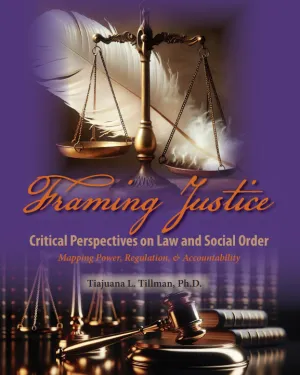
Framing Justice is a foundational university-level workbook designed to guide students through the essential questions, theories, and structures that shape justice in contemporary society. Blending philosophical inquiry with real-world application, this workbook introduces justice not as a fixed ideal, but as a concept continually shaped by power, law, and accountability.
Students will engage with major philosophical foundations of fairness and justice while learning how legal systems and social institutions operate in practice. Through carefully selected case studies, reflective exercises, and critical discussion prompts, the workbook encourages readers to analyze, debate, and critique how justice is defined, enforced, and challenged across diverse contexts. Special emphasis is placed on mapping power—who holds it, how it is exercised, and how accountability was either established or evaded through cases centering on indigenous ownership to deception within modern institutions.
Designed for introductory justice studies courses, Framing Justice supports active learning and critical thinking, equipping students with the analytical tools needed to fully understand justice in the twenty-first century and beyond. Whether examining law, social policy, or ethical responsibility, this workbook invites students to question assumptions, engage thoughtfully with complexity, and develop a deeper, more informed perspective on justice in an evolving world.