
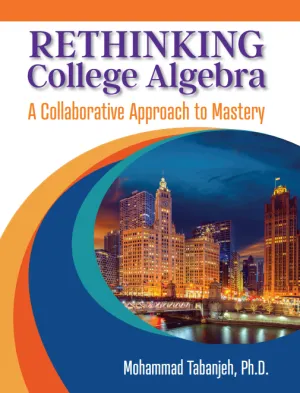
Rethinking College Algebra: A Collaborative Approach to Mastery

Author(s)
Mohammad Tabanjeh
Edition
1
Pages
198
Book Type
Academic

CHOOSE YOUR FORMAT

Help Me Choose

Paperback Book

$50.00

ISBN: 9798319737373
Details: 
Print Product

eBook

$25.00

ISBN: 9798319737380
Details: 
Electronic Delivery EBOOK - 365 days

CHOOSE YOUR FORMAT

Help Me Choose

Paperback Book

$50.00

ISBN: 9798319737373
Details: 
Print Product

eBook

$25.00

ISBN: 9798319737380
Details: 
Electronic Delivery EBOOK - 365 days

This book is an introductory college algebra textbook designed to support active, small group learning in the classroom. It presents essential algebraic concepts through a carefully structured sequence of seventeen concise chapters that integrate collaborative problem solving with applied activities. The content emphasizes clarity and focus, allowing students to build foundational skills while engaging meaningfully with key algebraic ideas. Core topics include linear and quadratic equations, inequalities, functions and their graphs, polynomial and rational functions, exponential and logarithmic functions, and systems of linear equations. Each lesson is intentionally designed to promote student participation, discussion, and peer-to-peer learning, shifting the classroom experience from passive lecture to active engagement. A central feature of the text is its emphasis on collaborative learning. Students are encouraged to work in small groups to explore concepts, solve problems, and articulate their reasoning. This approach fosters deeper conceptual understanding, strengthens problem solving skills, and supports improved retention. The structure aligns with current best practices in mathematics education, particularly in four-year colleges, community colleges, and co-requisite course settings. The textbook also incorporates applied projects which connect algebraic concepts to real world contexts. These projects are designed to reinforce learning, promote critical thinking, and provide opportunities for extended group investigation. The streamlined organization of the material offers instructors flexibility in pacing and implementation. The text is well suited for introductory college algebra courses, developmental or transitional algebra programs, and co-requisite support courses. By combining essential algebra content with a practical, student-centered instructional design, this textbook provides an engaging and effective alternative to traditional lecture-driven materials.

1. Linear Equations and Applications

2. Quadratic Equations and Applications

3. Radical Equations and Factoring Methods

4. Inequalities and Interval Notation

5. Equations and Inequalities Involving Absolute Value

6. Lines and their Graphs

7. Equations of Lines and Applications

8. Functions: Notation, Graph, Domain, and Range

9. Graphs of Functions

10. Library of Functions

11. Graphing Techniques and Transformations

12. Quadratic Functions and Models

13. Polynomial Functions

14. Rational Functions and Asymptotes

15. Exponential Functions and Equations

16. Logarithmic Functions and Equations

17. Systems of Linear Equations

Appendices

A.0 Instructions for Group Projects

A.1 Project 1: Line of Sight in the Rocky Mountains

A.2 Project 2: Comparing Transportation Costs

A.3 Project 3: Cell Phone Plans

Answer Key: Group Exercises

Answer Key: Practice Exercise

Index

Mohammad Tabanjeh

Dr. Mohammad Tabanjeh is a Professor of Mathematics at Virginia State University with more than two decades of experience in teaching, research, curriculum development, and graduate education. He earned his Ph.D. in Applied Mathematics from The City University of New York Graduate Center, where his work focused on algebraic and numerical computations. His research centers on computational mathematics, numerical linear algebra, and structured matrices. 

Dr. Tabanjeh has published scholarly work, presented at national and international conferences, supervised graduate research, and served in key academic leadership roles, including Graduate Program Director at Virginia State University. His work reflects a strong commitment to mathematical excellence, student success, and innovative approaches to teaching and learning.

This book is an introductory college algebra textbook designed to support active, small group learning in the classroom. It presents essential algebraic concepts through a carefully structured sequence of seventeen concise chapters that integrate collaborative problem solving with applied activities. The content emphasizes clarity and focus, allowing students to build foundational skills while engaging meaningfully with key algebraic ideas. Core topics include linear and quadratic equations, inequalities, functions and their graphs, polynomial and rational functions, exponential and logarithmic functions, and systems of linear equations. Each lesson is intentionally designed to promote student participation, discussion, and peer-to-peer learning, shifting the classroom experience from passive lecture to active engagement. A central feature of the text is its emphasis on collaborative learning. Students are encouraged to work in small groups to explore concepts, solve problems, and articulate their reasoning. This approach fosters deeper conceptual understanding, strengthens problem solving skills, and supports improved retention. The structure aligns with current best practices in mathematics education, particularly in four-year colleges, community colleges, and co-requisite course settings. The textbook also incorporates applied projects which connect algebraic concepts to real world contexts. These projects are designed to reinforce learning, promote critical thinking, and provide opportunities for extended group investigation. The streamlined organization of the material offers instructors flexibility in pacing and implementation. The text is well suited for introductory college algebra courses, developmental or transitional algebra programs, and co-requisite support courses. By combining essential algebra content with a practical, student-centered instructional design, this textbook provides an engaging and effective alternative to traditional lecture-driven materials.

1. Linear Equations and Applications

2. Quadratic Equations and Applications

3. Radical Equations and Factoring Methods

4. Inequalities and Interval Notation

5. Equations and Inequalities Involving Absolute Value

6. Lines and their Graphs

7. Equations of Lines and Applications

8. Functions: Notation, Graph, Domain, and Range

9. Graphs of Functions

10. Library of Functions

11. Graphing Techniques and Transformations

12. Quadratic Functions and Models

13. Polynomial Functions

14. Rational Functions and Asymptotes

15. Exponential Functions and Equations

16. Logarithmic Functions and Equations

17. Systems of Linear Equations

Appendices

A.0 Instructions for Group Projects

A.1 Project 1: Line of Sight in the Rocky Mountains

A.2 Project 2: Comparing Transportation Costs

A.3 Project 3: Cell Phone Plans

Answer Key: Group Exercises

Answer Key: Practice Exercise

Index

Mohammad Tabanjeh

Dr. Mohammad Tabanjeh is a Professor of Mathematics at Virginia State University with more than two decades of experience in teaching, research, curriculum development, and graduate education. He earned his Ph.D. in Applied Mathematics from The City University of New York Graduate Center, where his work focused on algebraic and numerical computations. His research centers on computational mathematics, numerical linear algebra, and structured matrices. 

Dr. Tabanjeh has published scholarly work, presented at national and international conferences, supervised graduate research, and served in key academic leadership roles, including Graduate Program Director at Virginia State University. His work reflects a strong commitment to mathematical excellence, student success, and innovative approaches to teaching and learning.

Other Titles from this Author(s)

No other titles found of this author