
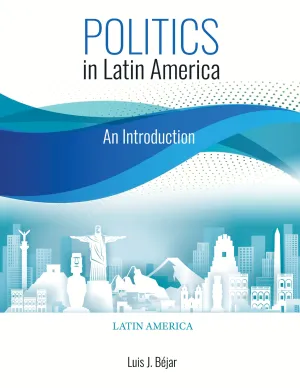
Bejar - cover

Politics in Latin America: An Introduction

Author(s)
Luis Bejar
Edition
1
Book Type
Academic
Retail

CHOOSE YOUR FORMAT

Help Me Choose

Paperback Book

$85.00

ISBN: 9798385195404
Details: 
Print Product

eBook

$55.00

ISBN: 9798385195411
Details: 
Electronic Delivery EBOOK - 365 days
CHOOSE YOUR FORMAT

Help Me Choose

Paperback Book

$85.00

ISBN: 9798385195404
Details: 
Print Product

eBook

$55.00

ISBN: 9798385195411
Details: 
Electronic Delivery EBOOK - 365 days
This book offers a comprehensive and structured analysis of Latin American political development, institutions, and challenges. It begins by exploring the conceptual and historical foundations of Latin America, tracing its evolution from pre-colonial civilizations through colonization, independence, and state-building.

Key themes include:

  • Colonial legacy and independence movements
  • State formation and national identity
  • Constitutionalism and institutional design
  • Democracy, political culture, and clientelism
  • Populism and authoritarianism
  • Public administration and corruption
  • Legislative and judicial powers
  • Human rights and the Inter-American system
  • Contemporary challenges including inequality, civil society, and U.S.–Latin America relations

The book integrates historical context with contemporary analysis, combining theoretical frameworks and empirical examples. It emphasizes the region’s diversity, the persistence of inequality, and the ongoing struggles for democratic consolidation and social justice.


Luis Bejar

Luis J. Béjar is a Canadian Mexican scholar with over 25 years of experience in law and political science. He holds a Ph.D. in Law and is currently completing a master's in political science at Université de Montréal. Luis has authored and edited more than 20 books and numerous peer-reviewed articles. He has taught and lectured in over a dozen countries across the Americas and Europe. Currently, he serves as Assistant Professor at Bishop's University at the Department of Politics & International Studies. Luis is a member of several international legal and academic organizations. He has received multiple fellowships and grants for his scholarly work.

This book offers a comprehensive and structured analysis of Latin American political development, institutions, and challenges. It begins by exploring the conceptual and historical foundations of Latin America, tracing its evolution from pre-colonial civilizations through colonization, independence, and state-building.

Key themes include:

  • Colonial legacy and independence movements
  • State formation and national identity
  • Constitutionalism and institutional design
  • Democracy, political culture, and clientelism
  • Populism and authoritarianism
  • Public administration and corruption
  • Legislative and judicial powers
  • Human rights and the Inter-American system
  • Contemporary challenges including inequality, civil society, and U.S.–Latin America relations

The book integrates historical context with contemporary analysis, combining theoretical frameworks and empirical examples. It emphasizes the region’s diversity, the persistence of inequality, and the ongoing struggles for democratic consolidation and social justice.


Luis Bejar

Luis J. Béjar is a Canadian Mexican scholar with over 25 years of experience in law and political science. He holds a Ph.D. in Law and is currently completing a master's in political science at Université de Montréal. Luis has authored and edited more than 20 books and numerous peer-reviewed articles. He has taught and lectured in over a dozen countries across the Americas and Europe. Currently, he serves as Assistant Professor at Bishop's University at the Department of Politics & International Studies. Luis is a member of several international legal and academic organizations. He has received multiple fellowships and grants for his scholarly work.

Other Titles from this Author(s)

Bejar - cover
Title: Politics in Latin America: An Introduction
Bejar Cover
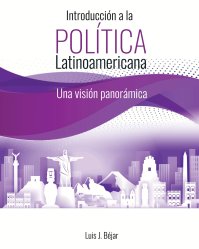
Title: Introducción a la Política Latinoamericana: Una visión panorámica